


Recently on a Sunday night my phone rang, showing an unknown number.
My iPhone screens the call, and the display shows “Coinbase withdrawal of 0.1 BTC was just initiated” from my account. I then pick up, press 1 to confirm it’s fraud, and the call immediately disconnects. A few seconds later, I received a call back.
The caller introduces himself as Alexander Evans (AE) from Coinbase Security and presents as calm, confident, and professional. He explains there was a suspicious withdrawal attempt from Germany and that he’s opening fraud case number 192382 on my behalf.
How Attackers Build Legitimacy Step by Step
AE starts by “verifying” me. He confirms my email address and phone number (both already exposed in public data breaches, but still effective). He also adds that the attacker tried to change my primary email to "philholbrookrecovery@protonmail.com." He then says he’s going to email me a confirmation message that I can ignore—but asks me to independently verify that it comes from a "coinbase.com" email address.
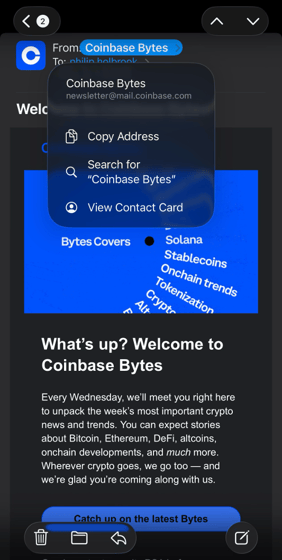
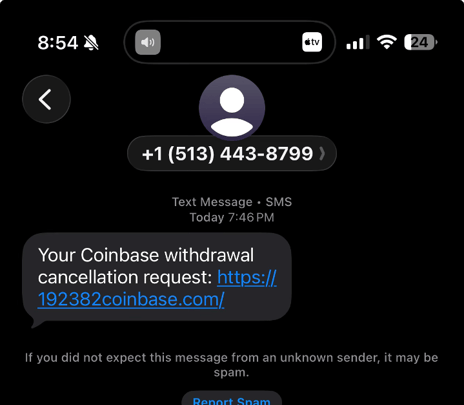
It is from coinbase.com, but it’s clearly just a Coinbase newsletter subscription confirmation. That’s the trick: not malicious in its own right, but still enough to anchor trust by making me validate the domain myself. Shortly after, I get a text message from the same number he called from: +1 (513) 443-8799.
At this point, I stop playing along silently and decide to dive deep to see if I’m actually compromised.
How to Detect a Phishing Attack in Real Time
I log into my Coinbase account directly (not via any links) and don’t see any suspicious activity. There are no unfamiliar logins and everything checks out. While still on the call, I run a few quick checks:
- Recent sign-ins: All mine, going back a year.
- Domain check: I look up the phishing domain he’s clearly warming up to send. You can typically do this via https://crt.sh, an online tool used for checking certificate transparency logs. It was registered on 12/30/2025, with no subdomains or anything else established.
- ProtonMail: Out of curiosity, I try to register that address ("philholbrookrecovery@protonmail.com") and see that It's available.
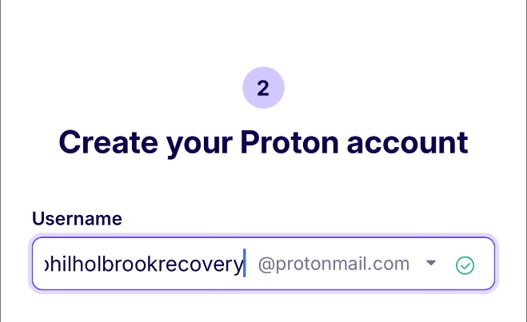
That last check is the smoking gun, causing his whole schpeel to collapse.
How to Respond to a Phishing Attack in Real Time
I ask again what Coinbase needs from me right now to resolve the fraud. That’s when AE pushes me to click the link he texted. He says he’ll provide a verification code once I’m on the page to “validate my case.”
Pushing back, I tell him plainly:
- "I’m not clicking links sent over SMS."
- "You called me out of the blue."
- "My Coinbase account shows no suspicious activity."
- "I have no direct fraud emails from Coinbase."
- "This scam stinks. I'm not clicking anything."
There’s a pause followed by laughter.
The Startling Frequency of Phishing Attacks
His response? “Man, you know this scam is good. Tell me what’s wrong with it?” He goes on to explain that he has 15-year-olds running this script all day and that it “gets grandmas all the time.” He gives me credit for checking the ProtonMail address and asks how his delivery was overall.
I tell him the truth: The opening was solid and the first five minutes were legitimately convincing. But the SMS link and freshly registered phishing domain blew the whole thing up. At least put it on a convincing subdomain if you want it to fly.
He insists it works constantly and that I’m just the first person he’s had who checked domains and email infrastructure. And, of course, I’m not going to be providing him with any real feedback to help him ruin someone’s day.
Then, surprisingly politely, he wishes me and my family a Happy New Year and confirms he’ll scrub my number from the system. No hard feelings. “Later bro.” And that was that.
What Makes Vishing Campaigns Convincing
This wasn’t a sloppy robocall scam. It was a coordinated vishing campaign:
- Cold automated call prompting urgency
- Immediate human follow-up
- Real Coinbase infrastructure leveraged for legitimacy
- Confident, professional social engineering
- A clear handoff from voice to SMS phishing
What made it unique was watching the operator drop the act and openly discuss the campaign once it failed. I’ve done my share of scam baiting and time-wasting over the years, but it’s rare to get a candid post-mortem straight from the attacker.
Lessons Learned from a Real-World Phishing Attack
- Pressing “1” is the hook. Once you engage, you’re flagged as responsive and likely enrolled into future campaigns.
- Real emails don’t equal real intent. Attackers will use legitimate services to bootstrap trust.
- SMS links are the pivot point. That’s where the real damage happens, and if you put in your credentials, you’re finished.
- Training matters. This attack would be successful on anyone who doesn’t understand DNS, email headers, and login history.
This attempted attack snuck up on me, and that’s the point. With today’s cyber threats, anyone can be vulnerable. It’s important to stay skeptical, verify independently, and not click on links sent to you by someone who called you first.
Fraud case 192382, closed.